Content Marketing In 2025: The Only Guide You Need
Key Takeaways
- Value-First Approach: Content marketing focuses on creating valuable, free content to attract an audience and build trust, shifting away from direct, interruptive advertising.
- Proven Business Benefits: It is a cost-effective strategy that builds brand authority, improves SEO, generates high-quality leads, and nurtures customers throughout their entire buying journey.
- Strategic Framework is Crucial: A successful content marketing plan requires a clear strategy built on five pillars: defining goals, understanding your audience, planning content, executing creation and distribution, and consistently measuring results for optimization.
Table of Contents
- What is Content Marketing? The Core Concept Explained
- Why Your Business Can’t Afford to Ignore Content Marketing
- Content Marketing vs. Inbound Marketing: What’s the Difference?
- The 5 Pillars of a Winning Content Marketing Strategy
- Common Types of Content Marketing in Action
- Start Your Content Marketing Journey Today
- Frequently Asked Questions
Are you tired of ads that shout at you? Do you immediately click “skip” on videos or flip past glossy magazine pages filled with pushy sales messages? If so, you’re not alone. Today’s customers are smart, and they want real value and genuine connection, not just a sales pitch. They want to be helped, not sold to.
This is where content marketing comes in. It’s the modern answer to this massive shift in consumer behavior. At its core, content marketing is the practice of creating and sharing valuable, free content to attract and build trust with your ideal audience. This ultimate guide to content marketing will show you everything you need to know. By the time you finish reading, you will understand what is content marketing, why it’s a non-negotiable part of any modern business, and how you can build a powerful strategy from the ground up.
What is Content Marketing? The Core Concept Explained
So, what is content marketing exactly? Let’s break it down with a clear definition.
Content marketing is a strategic marketing approach focused on creating and distributing valuable, relevant, and consistent content to attract and retain a clearly defined audience — and, ultimately, to drive profitable customer action.
Instead of directly selling your products or services, you are providing truly useful information that helps your audience solve their problems. This “value-first” approach is what makes content marketing so powerful. It builds deep, lasting trust and positions your brand as a helpful expert and a go-to resource in your industry.
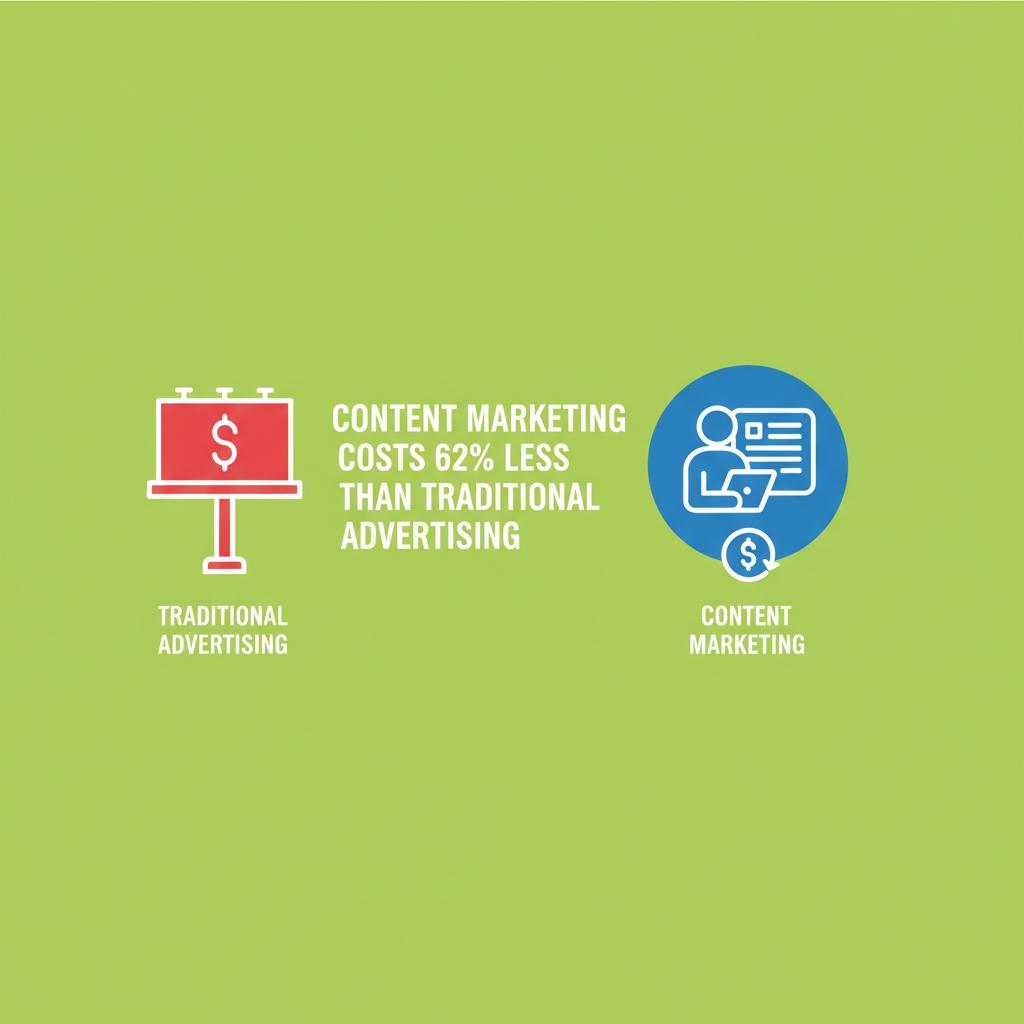
Think about the difference between content marketing and traditional advertising. A traditional ad interrupts you. It’s the commercial that stops your favorite TV show or the pop-up that blocks the article you want to read. Content marketing is the experience. It’s the helpful “how-to” blog post you found on Google, the entertaining video tutorial on YouTube, or the insightful podcast you listen to on your commute. You actively seek it out because it provides value. This method isn’t just more pleasant for the consumer; it’s also far more efficient for the business. In fact, studies show that content marketing costs 62% less than traditional advertising while delivering significantly better results.
Why Your Business Can’t Afford to Ignore Content Marketing
Adopting a content marketing mindset isn’t just a “nice to have” — it’s a critical engine for growth. The benefits are tangible, measurable, and can transform how you connect with customers. Here’s why your business needs to invest in content marketing today.
Builds Brand Trust and Authority
When you consistently publish high-quality, helpful content, you become a trusted authority in your field. People start to see your brand not just as a seller of goods, but as a reliable source of information. This trust is priceless. When a customer is finally ready to make a purchase, they are far more likely to choose the brand that has been helping them all along.
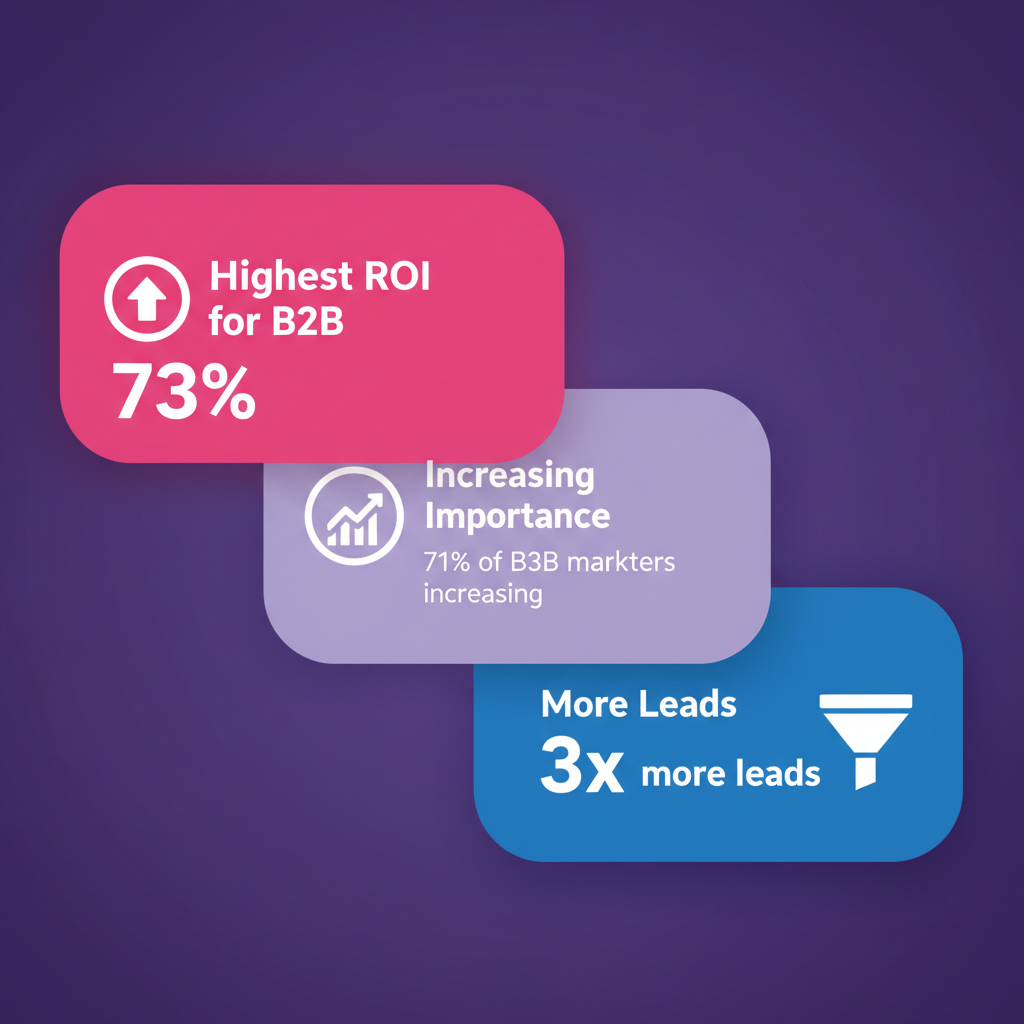
This is especially true in the business-to-business (B2B) world. For B2B companies, content marketing delivers the highest ROI, with formats like blogs and whitepapers leading the charge. A staggering 73% of B2B marketers report that content marketing is their top-performing strategy for return on investment. It’s no surprise, then, that 71% of B2B marketers said that content marketing became even more important to their organization over the last year.
Improves SEO and Drives Organic Traffic
Every blog post, video, or guide you publish is another page that search engines like Google can index. This means another opportunity for your business to show up in search results when potential customers are looking for answers. The more valuable content you create around relevant keywords, the more chances you have to attract organic traffic.
High-quality content is exactly what search engines want to provide to their users. By creating the best, most helpful resource for a specific problem, you align your goals with Google’s. This leads to higher rankings, more visibility, and a steady stream of visitors to your website who are actively interested in what you have to offer. As experts point out, organic traffic can be a powerful driver of business growth, and content is the fuel for that engine.
Generates High-Quality Leads
Traditional advertising often involves pushing a message out to a broad, uninterested audience. Content marketing does the opposite: it pulls in people who are already searching for solutions you provide. These individuals are not cold leads; they are warm prospects who have a genuine need or interest.
Because they find you through your helpful content, they enter your ecosystem with a positive impression of your brand. This makes them much more likely to convert into customers. The data backs this up decisively: content marketing generates three times more leads per dollar spent than traditional advertising. It’s a more efficient, effective, and sustainable way to fill your sales pipeline.
Educates and Nurtures Your Audience
The path to purchase is rarely a straight line. Customers have questions and concerns at every stage, from initial awareness to the final decision. Content is the perfect tool to guide them through this journey.
- Awareness Stage: A blog post titled “5 Signs You Need a New Project Management Tool” can help a potential customer identify a problem they didn’t even have a name for.
- Consideration Stage: A detailed comparison guide or a case study video can help them evaluate their options and see why your solution is the best fit.
- Decision Stage: A free demo, a webinar, or a detailed FAQ page can answer their final questions and give them the confidence to buy.
By creating content for each stage of the buyer’s journey, you nurture potential customers, answer their questions proactively, and make them feel empowered and confident in their decision to choose you.
Content Marketing vs. Inbound Marketing: What’s the Difference?
You may have heard the term “inbound marketing” used alongside “content marketing,” and it can be confusing to know how they relate. While they are closely linked, they aren’t the same thing.
Inbound marketing is a comprehensive business methodology. Its goal is to attract customers by creating valuable content and experiences specifically tailored to them. It’s a holistic approach that covers every stage of the customer’s journey, which is often broken down into three phases: Attract, Engage, and Delight. Inbound uses many tools to achieve this, including social media management, search engine optimization (SEO), customer relationship management (CRM), and more.
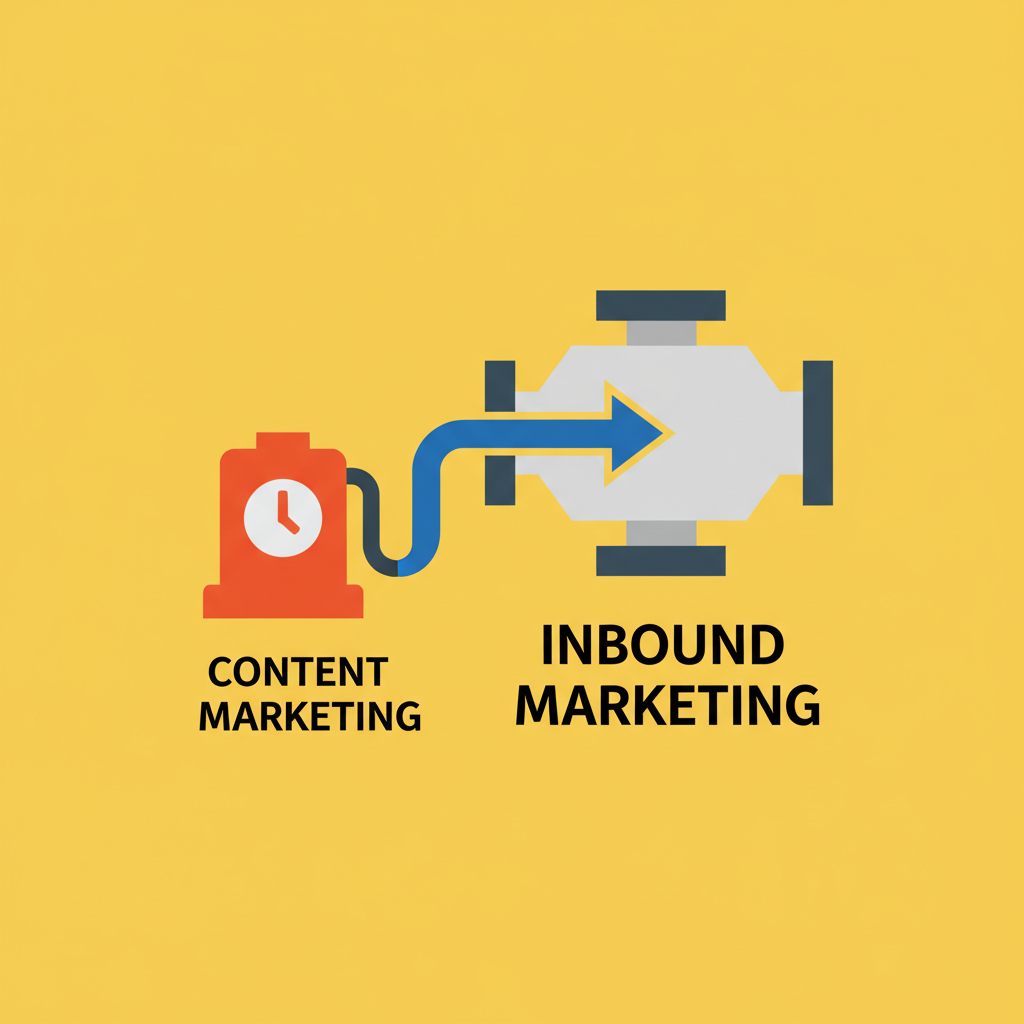
Content marketing is a vital component of inbound marketing. It is the primary tactic used to execute the “Attract” and “Engage” stages of the inbound methodology. It’s the creation of the blog posts, videos, ebooks, and other assets that draw people in and build the relationship.
Here’s a simple analogy to make it clear:
If inbound marketing is the entire car engine, then content marketing is the high-octane fuel that makes it run. You can’t have one without the other for a smooth, powerful ride.
Inbound provides the overall strategy and framework, while content provides the substance and value that powers the entire process.
The 5 Pillars of a Winning Content Marketing Strategy

Creating content without a plan is like setting sail without a map—you’ll be busy, but you won’t get anywhere. A successful content marketing strategy is built on five core pillars that guide your efforts and ensure you get a real return on your investment.
Pillar 1: Define Your Goals & KPIs
Before you write a single word, you must know why you’re doing it. What business objective are you trying to achieve? A strategy without clear goals is just creating content for the sake of it.
Your goals could be:
- Increase Brand Awareness: Getting your name in front of more people in your target market.
- Generate Leads: Capturing contact information from potential customers.
- Improve Customer Retention: Providing value to existing customers to keep them loyal.
- Drive Sales: Directly connecting content to product purchases.
Once you have a goal, you need Key Performance Indicators (KPIs) to measure your progress. For brand awareness, you might track website traffic and social media shares. For lead generation, you’d track form submissions and email sign-ups. This measurement is not optional. Marketers who track their results are far more successful; in fact, 59% of marketers who measure their content marketing rate their ability to show a positive ROI as excellent or very good. On the flip side, a surprisingly large number of businesses are flying blind, as 47% of marketers are not tracking ROI from their content efforts at all.
Pillar 2: Identify Your Audience (Buyer Personas)
You cannot create valuable content if you don’t know who you’re creating it for. This is where buyer personas come in. A buyer persona is a semi-fictional, detailed profile of your ideal customer based on market research and real data.
Creating a persona helps you step into your customer’s shoes and understand their world. Your persona profile should include:
- Demographics: Age, job title, industry, location.
- Goals: What are they trying to achieve in their job or life?
- Challenges: What obstacles are standing in their way?
- Pain Points: What frustrates them or keeps them up at night?
Don’t just guess! The best way to build accurate personas is to interview your real customers, talk to your sales team, and analyze your customer data. Once you deeply understand your persona, creating content that resonates with them becomes infinitely easier.
Pillar 3: Content Ideation & Planning
Now that you know your goals and your audience, it’s time to brainstorm content ideas. The best topics live at the intersection of your audience’s pain points and your business’s expertise. Use keyword research tools to see what terms your audience is searching for online.
Once you have a list of ideas, organize them with a content calendar. A content calendar is a schedule that maps out what content you will publish, when you will publish it, and on which channels. This keeps your team organized and ensures you are publishing consistently. As you plan for the future, consider new and emerging formats. Looking ahead, 62% of marketers plan to include interactive content in their 2024 strategies, and 52% of businesses have plans to try AI video generators. While AI tools are on the rise, adoption for content creation itself is still in its early days, with only 3.2% of content marketers planning to incorporate them into their core efforts, making it a potential area for early adopters to gain an edge.
Pillar 4: Content Creation & Distribution
This is the pillar where your ideas come to life. Whether you’re writing blog posts, recording videos, or designing infographics, focus on quality above all else. Your content should be well-researched, well-produced, and genuinely helpful.
But remember, creation is only half the battle. Distribution is what gets your content in front of your target audience. You can have the greatest article in the world, but if no one sees it, it doesn’t matter. Common distribution channels include:
- Social Media: Sharing your content on platforms like LinkedIn, Instagram, or TikTok.
- Email Newsletters: Sending your latest content directly to your subscribers’ inboxes.
- Search Engine Optimization (SEO): Optimizing your content to rank in Google search results.
- Paid Promotion: Using ads to boost the reach of your best-performing content.
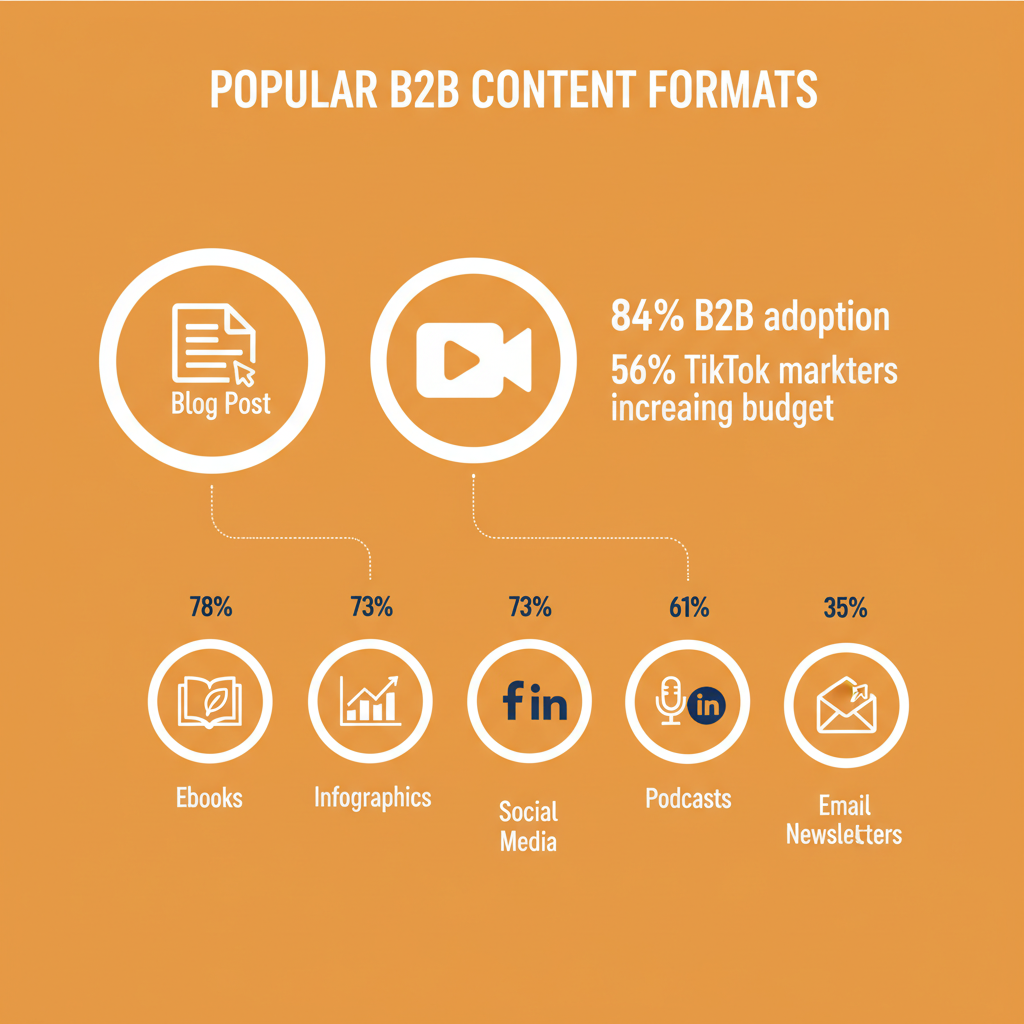
When it comes to creation, B2B marketers are currently focused on two main formats. The most popular content types are short articles/posts (94%) and videos (84%). The dominance of video is clear across the board, with one survey finding that a massive 91% of companies were using video content as part of their marketing efforts.
Pillar 5: Measure, Analyze, & Optimize
The final pillar closes the loop on your strategy. After you’ve published and distributed your content, you need to go back to your goals and KPIs from Pillar 1 and see how you performed. Analyze what worked, what didn’t, and why.
Look at key metrics to understand performance. According to research, the metrics B2B marketers rely on most are conversions, lead quality, and website engagement. This data is the key to improving. Perhaps you found that videos drive more engagement than blog posts, or that articles about a specific topic generate the highest quality leads. This insight is gold. Use it to refine your content marketing strategy and optimize your future efforts for even better results. The importance of data can’t be overstated; around 26% of marketers agree that having good data directly increases their overall ROI. It’s a practice that is becoming standard, as over 41% of marketers now measure the success of their content strategies.
Common Types of Content Marketing in Action
Content marketing isn’t just one thing; it’s an umbrella term for many different formats. The key is to choose the formats that best suit your audience and your goals. Here are some of the most common and effective types of content.
Blog Posts & Articles
Blogs are often the cornerstone of a content marketing strategy. They are perfect for improving SEO, answering specific customer questions, and establishing your expertise. Among B2B marketers, short articles and posts are the most widely used format, with 94% adoption. When properly optimized for search engines, blog articles are a key tool for generating awareness and traffic at the top of the marketing funnel.
Video Content
Video is an incredibly engaging format that can be used for tutorials, product demos, customer testimonials, behind-the-scenes looks, and brand storytelling. Its popularity is undeniable, as it’s the second most popular format for B2B marketers, with 84% using it. The investment is well worth it, as marketers consistently report a high ROI on video content. The trend is only growing, with 56% of TikTok marketers planning to increase their video production budgets in 2024.
Ebooks & Whitepapers
These are longer, more in-depth pieces of content that are typically “gated,” meaning a user has to provide their contact information (like an email address) to download them. This makes them one of the best types of content for lead generation. Ebooks are great for comprehensive guides, while whitepapers are ideal for presenting data, research, and expert analysis.
Infographics
Infographics use visuals like charts, graphs, and icons to present complex information in an easy-to-digest and highly shareable format. They are an excellent way to simplify data and make key statistics memorable. Because they are so visual, they are perfect for grabbing attention on social media and are listed as a useful format for top-of-funnel traffic and brand awareness. Modern versions, such as animated infographics, can make the experience even more engaging.
Social Media Content
This includes posts, stories, reels, and videos created specifically for platforms like Instagram, LinkedIn, Facebook, and TikTok. Social media is crucial for building a community, distributing your other content, and engaging with your audience in real-time. Formats like social media videos are considered highly valuable for building brand awareness.
Podcasts
Podcasts are a powerful way to build a deep, personal connection with your audience. Through long-form audio, you can conduct interviews with industry experts, share your own insights, and establish your brand as a thought leader. Listeners can tune in during their commute, at the gym, or while doing chores, making it a very convenient way to consume content.
Email Newsletters
An email newsletter is one of the most valuable assets in content marketing. It’s a direct line of communication to your most engaged audience—people who have actively chosen to hear from you. Newsletters are essential for nurturing leads, promoting your latest content, announcing new products, and keeping your brand top-of-mind.
Start Your Content Marketing Journey Today
Content marketing is not a short-term campaign; it’s a long-term commitment to building trust by providing consistent, undeniable value. It is a more effective, more sustainable, and less costly way to grow your business than disruptive, traditional advertising.
The difference between creating content and achieving real business results lies in your content marketing strategy. By following the five pillars—defining goals, knowing your audience, planning your content, creating and distributing effectively, and measuring your results—you can build a powerful engine for growth.
Don’t get overwhelmed by all the possibilities. The journey begins with a single step. Think of one common question your customers always ask. Now, go create one simple blog post or a short video that answers it perfectly. Your journey starts with that one piece of valuable content. Go create it.
Frequently Asked Questions
What is the main difference between content marketing and traditional advertising?
Traditional advertising interrupts an audience to push a sales message, like a TV commercial or a pop-up ad. Content marketing attracts an audience by providing valuable and helpful information that they actively seek out, such as how-to guides or tutorials. The goal is to build long-term trust and authority rather than making an immediate sale.
How do I measure the ROI of my content marketing efforts?
Measuring ROI starts with the goals you set in your strategy. Key Performance Indicators (KPIs) can include website traffic from organic search, conversion rates on lead-generating content (like ebook downloads), lead quality, social media engagement, and ultimately, sales revenue that can be attributed to content-driven leads.
Which type of content is best for a beginner?
Blog posts and short articles are often the best starting point. They are relatively low-cost to produce, are excellent for SEO, and allow you to directly answer your audience’s most common questions. This helps you quickly establish your brand as a helpful authority in your niche.